Accounting Websites That Attract Clients Year-Round
Tax season brings a rush, but what about the other 9 months? A website that ranks on Google generates bookkeeping, advisory, and planning leads all year.
- Custom design, no templates
- Online booking + SEO included
- Launched in 3–10 business days
featured in








Why accountants need a better website.
Seasonal business needs year-round pipeline
Bookkeeping, advisory, and planning fill the off-season, if your site ranks.
Trust is paramount when handling money
A polished, secure site signals you handle finances the same way.
Competing against TurboTax and DIY tools
Show prospects the value only a real CPA can provide.
What a great accountant website includes.
Service pages by type
Tax prep, bookkeeping, advisory, payroll, each its own page.
Client portal link
Secure sign-in for existing clients.
Secure document upload
Stop emailing tax docs around.
Free consultation booking
Lower the barrier to first contact.
Credentials display
CPA, CGA, and designations prominent.
Industry specialization pages
Restaurants, real estate, dentists, each ranks separately.
Tax deadline reminders
Drives traffic and demonstrates value.
Resource library
Calculators, checklists, guides.
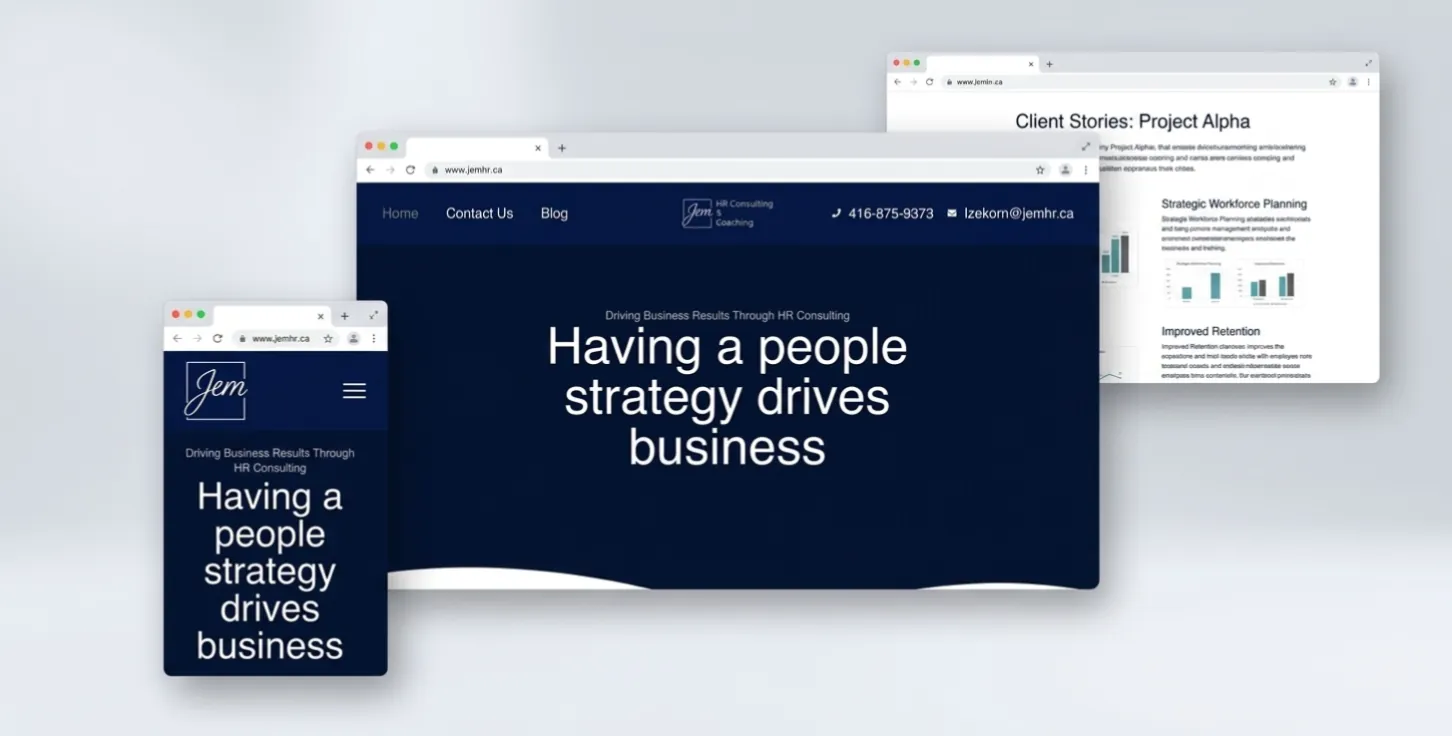
Recent client work.
Jem HR
Toronto
- Per-service pages for tax / bookkeeping / advisory / payroll
- Secure client portal sign-in
- Industry pages for restaurants, dental, real estate
Simple, transparent pricing.
Most accounting firms choose the Professional plan because they need separate service pages, portal access, and a year-round resource library.
Starter
Solo CPA site.
- 3 pages
- Services + bio
- Contact form
- Basic SEO
Professional
Full firm site.
- 5–10 pages
- Per-service pages
- Portal link
- Resource library
- Local SEO + GBP
Custom
Multi-partner firms.
- Partner bios
- Industry pages
- Document upload
- Custom CMS
Why accounting firms need a year-round content engine, not a tax-season landing page.
Most accounting firm websites are built like seasonal storefronts, a homepage, a tax-prep page, a contact form. That structure brings in tax-season clients in March and April and goes dormant the other 10 months. The firms growing fastest treat their site as a year-round content engine that produces bookkeeping, advisory, payroll, and CFO leads on a steady monthly cadence.
What that looks like in practice: separate landing pages for each service line (tax prep, bookkeeping, advisory, payroll, fractional CFO) targeting both ‘[service] [city]' and ‘[service] for [industry]' searches; a resource library with calculators, checklists, and seasonal guides that earn organic traffic; and an email list for tax deadline reminders and quarterly planning that converts existing relationships into more billable work.
We typically build accounting sites with 8–15 individual landing pages, far more than a generic small-business site needs, because each represents a distinct search market. A bookkeeping page for restaurants ranks separately from a fractional CFO page for SaaS, and both are higher-intent than a generic ‘CPA Toronto' page.
Industry specialization pages: the highest-ROI move for accounting firm SEO.
Generic ‘accountant in [city]' pages compete against every accountant in your area, a brutal race to the bottom on price. Industry specialization pages, ‘bookkeeping for restaurants', ‘tax services for dentists', ‘fractional CFO for e-commerce', ‘accountant for real estate investors', target lower-competition long-tail keywords with much higher buyer intent.
A prospect searching ‘accountant for my Shopify store' is far closer to hiring than someone searching ‘accountant near me'. They've already qualified themselves. The page just needs to demonstrate domain expertise (industry-specific tax credits, common bookkeeping mistakes, COGS treatment, sales tax nexus) and route them to a consultation.
We build these pages around the actual problems each industry faces, not just keyword stuffing. A restaurant page talks about tip pooling, food cost percentages, and provincial liquor reporting. A dental page talks about associate vs. principal compensation, equipment depreciation, and HST on cosmetic procedures. The specificity is what converts.
Client portals, secure document upload, and the trust signals that close consultations.
Money is the highest-trust purchase a small business makes. The website has to signal competence and security in the first 5 seconds: clean design (not the busy clip-art-and-stock-photos look that plagues accounting sites), real photos of the team with credentials visible (CPA, CA, EA, CGA), prominent client testimonials with full names and businesses, and a visible client portal link.
For document upload, we recommend integrating your existing client portal (TaxDome, SmartVault, ShareFile, Karbon, Canopy) rather than building custom upload, those tools are SOC 2 compliant and built for IRS/CRA-level data sensitivity. The site adds a ‘Client Login' button in the header and an ‘Upload Documents' link in the footer that opens the portal directly.
On consultations, a free 30-minute consultation booking link converts 5–10× better than ‘call us' or ‘email us'. We add prominent booking buttons on every service page, with a brief intake form (entity type, revenue range, current accountant situation) that lets you triage and prep before the call.
Get a free accountant homepage design.
We'll design a homepage built for your business in 48 hours. Free. No obligation. Yours to keep.
Accountants FAQ.
Accountants web design in your city.
City-specific accountant web design pages with the regulatory and market details for each metro.
Related industries
Available in your city
Your free homepage design is 30 seconds away.
No cost. No obligation. Delivered to your inbox in 48 hours.
or call (647) 362-9754