For Real Estate Agents
Websites that turn browsers into buyers and sellers.
Purpose-built for Canadian realtors. IDX-ready, SEO-first, lead-obsessed.
Your brokerage site looks like every other agent's.
Same template. Same headshot pose. Zero differentiation.
Neighbourhood guides that rank in Google.
Own ‘Leslieville real estate', ‘Yorkville homes for sale', and every area you work.
Home valuation lead magnets that convert 3–5x.
Sellers hand over their address, email, and phone. You follow up in 24 hours.
Ready to outrank every other agent?
Get a free custom homepage mockup for your real estate business. No obligation, yours to keep.
Why real estate agents need a better website.
Brokerage sites are generic
Same template as hundreds of other agents. Zero differentiation.
50,000+ agents in the GTA alone
Personal branding is the only way to stand out in a crowded market.
Buyers and sellers research heavily
Your website is your first impression, and they're comparing you.
What a great real estate agent website includes.
Property listings
Manual showcases or full IDX/MLS integration.
Neighbourhood guides
Local market data that ranks for ‘[area] real estate.'
Home valuation lead magnet
‘What's your home worth?', our highest-converting tool.
Buyer & seller resources
Guides that build trust and capture emails.
Agent bio
Credentials, story, and personality, not a brokerage headshot.
Testimonial showcase
‘Sold in 3 days, $50K over asking.'
Market update blog
Monthly content that drives organic search.
CRM integration
Pipe leads straight into Follow Up Boss, Chime, or HubSpot.
Recent client work.
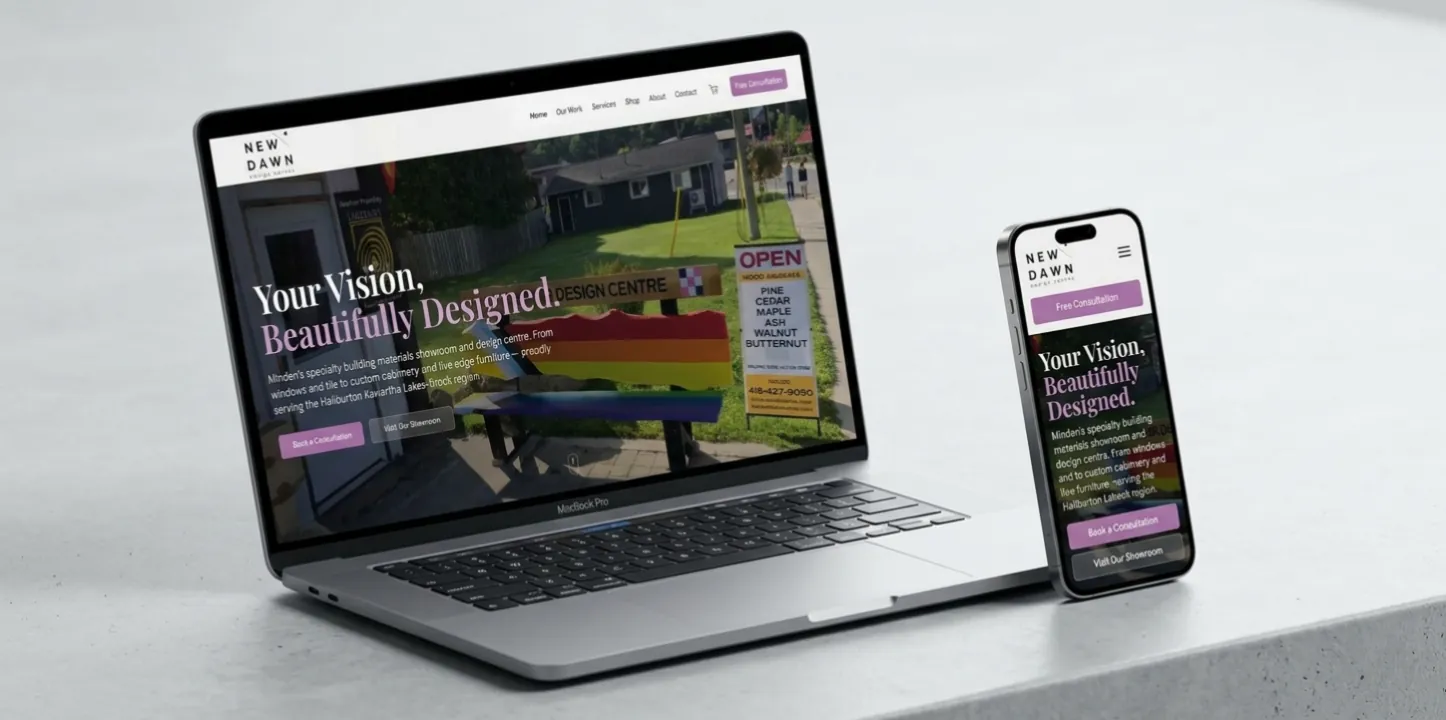
New Dawn Design Centre
Ontario
- Home valuation lead magnet generates qualified seller leads
- Neighbourhood guides rank for ‘[area] real estate' searches
- Personal brand site distinct from brokerage template
Simple, transparent pricing.
Most agents choose Professional for personal branding + lead capture, or Custom when they need full IDX integration.
Starter
Personal brand site, no listings.
- 3 pages
- Bio + testimonials
- Lead form
- Basic SEO
Professional
Full personal brand + lead capture.
- 5–10 pages
- Valuation lead magnet
- Neighbourhood guides
- Blog
- Local SEO + GBP
Custom
IDX/MLS integration & teams.
- IDX/MLS feed
- Team profiles
- CRM integration
- Advanced SEO
Why real estate agent websites should sell the agent, not the listings.
Most real estate agent websites are built around listings. IDX feed of every property in the area, search filters, map view, saved-searches signup. The problem is that prospects researching agents are not researching listings, they're evaluating which agent to hire. Listings are commodities (every agent has access to the same MLS). The agent is the differentiator.
We build real estate agent sites where the agent is the centerpiece, substantive bio, real photos (not the realtor stock pose), neighbourhood expertise demonstrated through detailed neighbourhood guides, recent sold listings with stories about the work involved, client testimonials with names and properties (where permitted), and a clear point of view on the local market.
Listings still appear (usually as an embedded IDX feed for search) but they're not the primary content. The neighbourhood guides and the agent bio drive the inbound traffic; the listings serve the prospect once they've decided you're the right agent. Agents who flip this model, agent first, listings second, consistently outperform agents who run listing-first sites.
Neighbourhood guides: the SEO content that drives qualified buyer and seller leads.
The single highest-ROI content investment for real estate agents is detailed neighbourhood guides. Each guide covers a specific neighbourhood: market data (median price, days on market, sold-vs-asking ratio, year-over-year trend), what it's like to live there (schools, transit, amenities, character), recent comparable sales, and the agent's personal take on the area.
These guides rank in Google for high-intent searches like ‘living in Leslieville', ‘Yorkville real estate market', ‘best neighbourhoods in Mississauga'. Buyers researching where to live read them carefully and convert into buyer-rep relationships at high rates. Sellers researching their neighbourhood's market value also read them and convert into listing presentations.
We typically build 6–15 neighbourhood guides per agent, focused on the neighbourhoods they specialize in or want to specialize in. The guides take real work, they need genuine market data, real personal voice, and ongoing updates as conditions change. The agents who invest in this content consistently outrank larger brokerages and lead-gen sites because they have something those competitors don't: actual local expertise written in a real human voice.
Buyer/seller dual-track design and the conversion paths that actually work.
Buyers and sellers have completely different journeys, but most agent websites treat them as a single audience. Buyers are usually 3–18 months out from transacting, want neighbourhood research and listing alerts, and convert through long-cycle nurture. Sellers are usually 1–6 months out, want a market valuation and a sense of the agent's selling track record, and convert through a faster cycle (often after a single listing presentation).
We build agent sites with two distinct content tracks, a ‘For Buyers' path leading through neighbourhood guides, market education, and a buyer-rep consultation booking, and a ‘For Sellers' path leading through recent sold listings, the agent's marketing approach, and a free home-valuation request. The site navigation makes both paths obvious from the homepage.
Conversion paths differ too. Buyers get a saved-search signup and a long-cycle email nurture (monthly market updates, new listings, neighbourhood content). Sellers get a fast-response valuation form (with a personal call or visit within 24 hours) and shorter-cycle content (recent sales in their area, marketing case studies, listing presentation videos). Lumping them into one ‘contact us' form costs leads in both directions.
Get a free real estate agent homepage design.
We'll design a homepage built for your business in 48 hours. Free. No obligation. Yours to keep.
Real Estate Agents FAQ.
Real Estate Agents web design in your city.
City-specific real estate agent web design pages with the regulatory and market details for each metro.
Related industries
Available in your city
Your free homepage design is 30 seconds away.
No cost. No obligation. Delivered to your inbox in 48 hours.
or call (647) 362-9754