Dental Websites That Fill Your Appointment Book
77% of patients search online before choosing a dentist. They look at your website, your reviews, and your photos. An outdated site signals an outdated practice.
- Custom design, no templates
- Online booking + SEO included
- Launched in 3–10 business days
featured in








Why dentists need a better website.
Patients judge practice quality by website
Your site is your first impression, and it's everyone's first impression.
Old websites signal outdated care
If your site looks like 2012, patients assume your equipment does too.
77% of patients search online first
Local SEO is no longer optional, it's the entire top of the funnel.
What a great dentist website includes.
Online appointment booking
Patients pick service, dentist, and time online.
Digital intake forms
Save 15 minutes per first appointment.
Service descriptions with photos
Demystify procedures before the consult.
Dentist & hygienist bios
Build trust before the first appointment.
Insurance accepted list
Removes the #1 barrier to booking.
Before/after smile gallery
Cosmetic dentistry's most powerful sales tool.
Patient testimonials
5-star reviews embedded in context.
Emergency contact
Toothache calls answered fast.
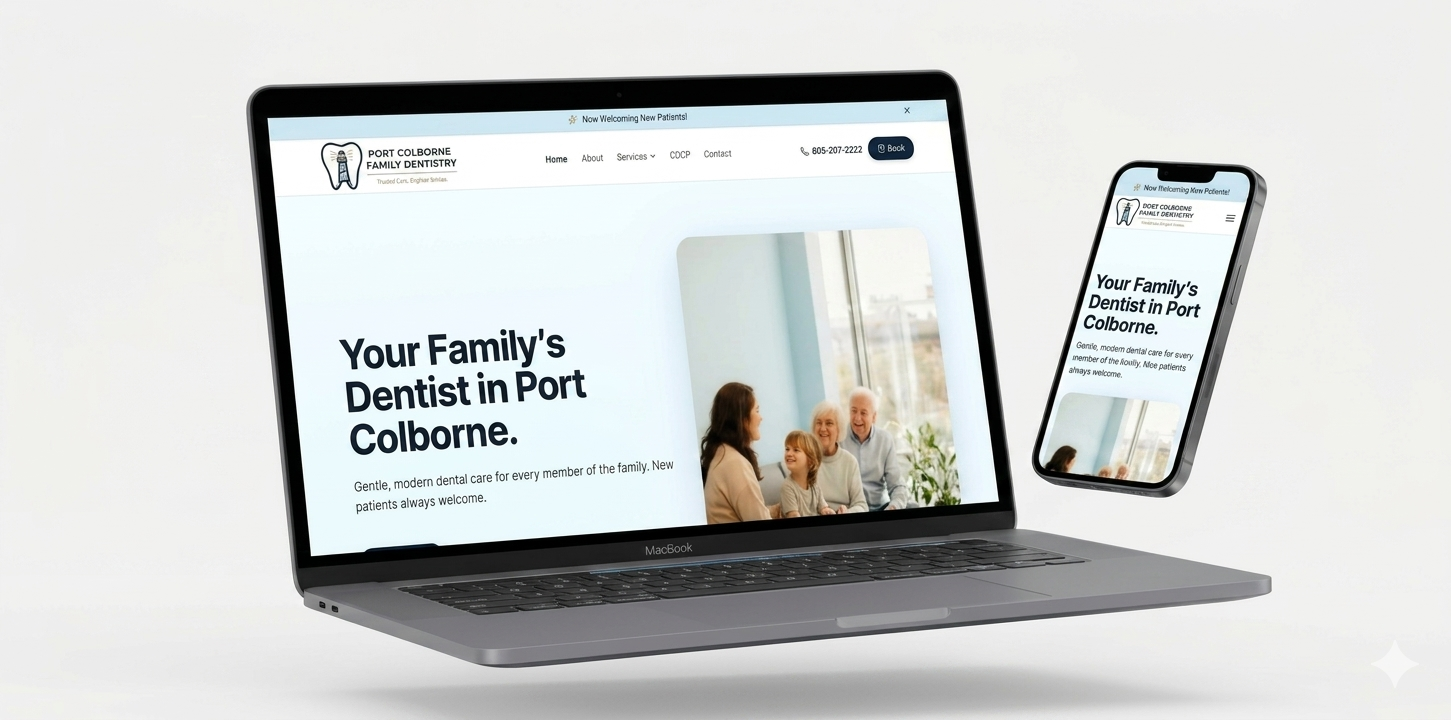
A real dentist website we built.
Port Colborne Family Dentistry
Port Colborne, ON
- Online booking + digital intake forms integrated
- Insurance list filterable by provider
- Smile gallery and testimonial showcase
Simple, transparent pricing.
Most dental practices choose the Professional plan because they need booking, intake forms, dentist bios, and a smile gallery.
Starter
Simple practice site.
- 3 pages
- Mobile-first
- Click-to-call
- Basic SEO
Professional
Full dental practice site.
- 5–10 pages
- Online booking
- Intake forms
- Smile gallery
- Local SEO + GBP
Custom
Multi-location practices.
- Multi-location
- Patient portal
- Custom CMS
- Advanced SEO
Why patients judge your practice by your website before they call.
77% of patients research a dental practice online before booking. They look at the website first, then the Google reviews, then the photos. If your site looks like it was built in 2012, the assumption, fair or not, is that the equipment, the techniques, and the standard of care are also from 2012. This matters most for cosmetic dentistry and Invisalign, where patients pay out of pocket and shop carefully across 4–6 practices before picking one.
A modern dental site signals competence in three seconds: clean typography, real photos of the office and team (not stock), clearly displayed services, visible pricing or insurance information, and a friction-free booking path. Patients aren't dental-website connoisseurs, but they recognize ‘this looks like a place I'd trust' or ‘this looks like a place I'd avoid' instantly.
We build dental sites in the calm, premium aesthetic that maps to how patients want to feel about their dentist, bright but not sterile, professional but warm, with a strong focus on team photography. Cosmetic-heavy practices get more before/after-forward designs. Family practices get more team-and-environment-forward designs.
Online booking, intake forms, and PMS integration done right.
Most dental practices think they ‘have online booking' because there's a phone number and a contact form. That isn't booking, it's phone tag. Real online booking lets a patient pick a service (cleaning, exam, whitening, emergency), pick a provider (dentist or hygienist), pick an available time, and confirm, all without anyone in the office being involved until the patient walks in.
We integrate with the major dental PMS platforms. Dentrix, ABELDent, Open Dental, Eaglesoft, Curve Dental, Dentrix Ascend, typically through their API or via a third-party booking layer like NexHealth, RevenueWell, or Solutionreach. The booking flow is embedded inline (not a redirect to a third-party calendar), which keeps conversion high and brand experience consistent.
Digital intake forms are the second biggest workflow win. Patients fill out medical history, insurance, and consent on their phone the night before. Data is encrypted in transit and routed to a HIPAA/PIPEDA-compliant inbox or directly into your PMS. This typically saves 10–15 minutes of front-desk time per new patient, meaningful when you're booking 5+ new patients a day.
Local SEO and Google Business Profile for dental practices.
‘Dentist near me', ‘[city] dentist', and ‘emergency dentist [city]' are among the highest-intent local searches on Google. Winning them is mostly about three things: a fully optimized Google Business Profile, local + medical schema markup on the site, and dedicated landing pages for high-value services like Invisalign, dental implants, and whitening targeting your specific city.
We also recommend a steady review-collection workflow. Practices that dominate ‘dentist near me' results almost always have 200+ Google reviews with a 4.7+ average. We set up a post-appointment SMS/email flow that asks happy patients to leave a Google review with one tap. Most practices go from 30 reviews to 150+ in their first year of having this in place.
For multi-location practices, each location gets its own page with location-specific schema, photos, team, hours, and service emphasis. Done correctly, each location ranks independently in its own neighbourhood, a major advantage over practices with a single combined page.
Get a free dentist homepage design.
We'll design a homepage built for your business in 48 hours. Free. No obligation. Yours to keep.
Dentists FAQ.
Dentists web design in your city.
City-specific dentist web design pages with the regulatory and market details for each metro.
Related industries
Available in your city
Your free homepage design is 30 seconds away.
No cost. No obligation. Delivered to your inbox in 48 hours.
or call (647) 362-9754