Construction Management Websites That Win More Projects
Developers and GCs research online before meetings. Your website needs to showcase project scale, team credentials, and safety record at a glance.
- Custom design, no templates
- Online booking + SEO included
- Launched in 3–10 business days
featured in








Why construction management need a better website.
B2B credibility determines who gets invited to bid
Your site is the screening tool before a single phone call.
Decision-makers research firms online
If your portfolio doesn't exist online, neither do you.
Must showcase scale, reliability, safety
All three at a glance, or the next firm gets the RFP.
What a great construction management website includes.
Project portfolio with scope
Timeline, budget tier, and scope per project.
RFP / bid request form
Capture qualified inbound from developers.
Team bios with certifications
PMP, LEED, P.Eng, credentials that win bids.
Safety record display
EMR ratings and certifications prominent.
Service area map
Show coverage clearly.
Developer / GC testimonials
Quotes from people whose names matter.
Industry awards
Recognition that earns credibility.
Project metrics dashboard
Square footage delivered, on-budget rate.
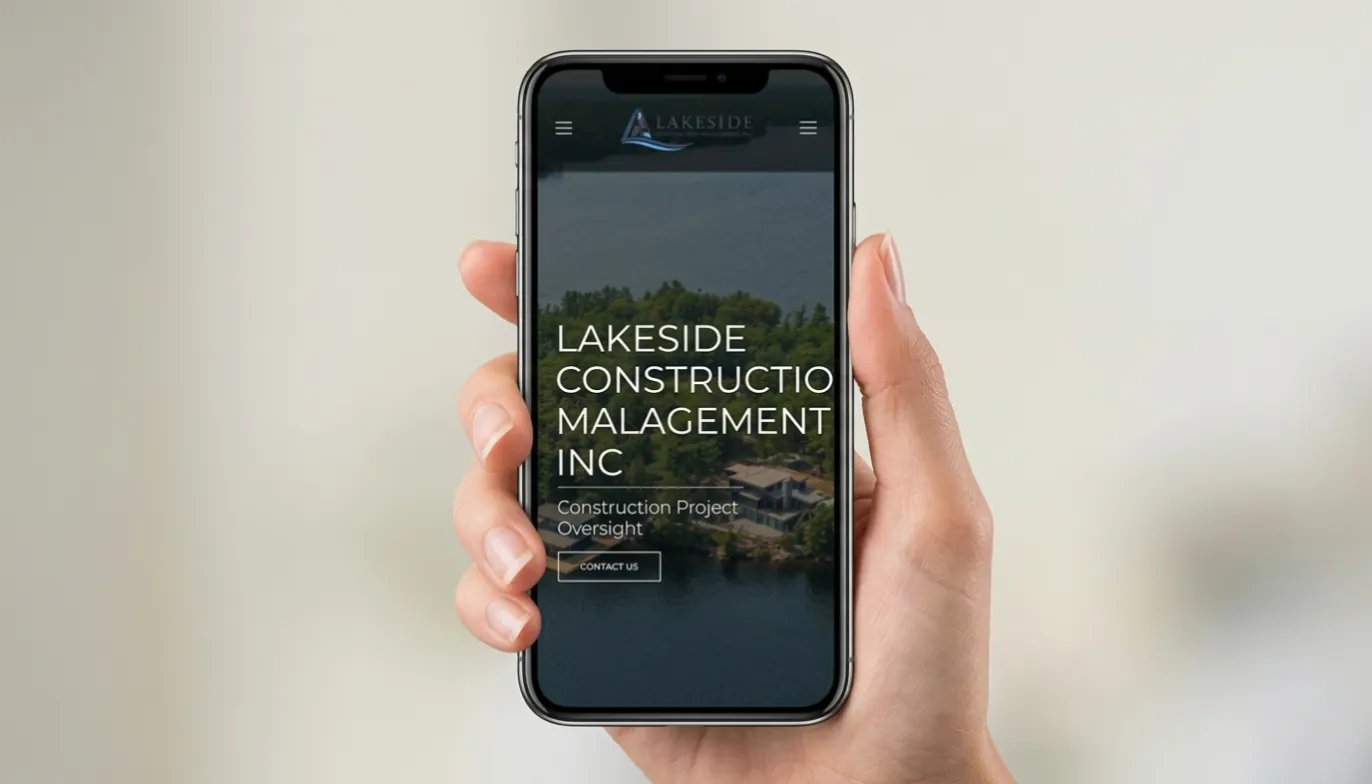
A real construction management website we built.
Lakeside Construction
Ontario
- Project portfolio sortable by scope and budget tier
- RFP form qualifying lead, scope, timeline
- Safety + certifications above the fold
Simple, transparent pricing.
Most construction management firms choose Professional or Custom because they need a robust project portfolio, RFP capture, and credentials display.
Starter
Simple firm site.
- 3 pages
- Bio + services
- Contact form
- Basic SEO
Professional
Full firm site.
- 5–10 pages
- Project portfolio
- RFP form
- Team bios
- B2B SEO
Custom
Multi-division firms.
- Per-division pages
- Per-project case studies
- Custom CMS
- Advanced SEO
Why construction management firms need a website built around credibility, not just lead-gen.
Construction management is a credibility-driven sale. Decisions are made by owners, developers, and institutional clients evaluating whether your firm can be trusted with $5M, $50M, or $500M in capital. The website's job isn't to drive a quick form fill, it's to demonstrate competence, credentials, safety record, and project history at a level that makes the firm a credible candidate for the RFP.
We build construction management sites around three pillars: a project portfolio that demonstrates scale and complexity (with each major project as its own page including budget range, timeline, scope, sub-trades managed, and client testimonial); a leadership and team section that prominently displays credentials (PMP, LEED AP, CCM, Gold Seal, ASA), licenses, and insurance limits; and a capabilities section that maps cleanly to the project types you pursue (commercial, institutional, healthcare, infrastructure, mixed-use).
Awards, certifications, and industry memberships matter disproportionately at this scale. We build dedicated sections for these, not as badges in a footer, but as substantive credibility content. Owners and architects evaluating fit for an RFP read these pages carefully.
Project portfolios at scale: how to organize a 50+ project history.
Construction management firms typically have decades of project history, and presenting that work effectively is a structural challenge most firm websites get wrong. The two failure modes: cramming everything into a single overwhelming gallery, or showing only the 6 ‘hero' projects and burying the depth of experience. The right answer is a filterable portfolio with each major project as its own indexable page.
We build portfolios that filter by sector (commercial, institutional, healthcare, hospitality, education, infrastructure), delivery method (CM at-risk, design-build, construction management, IPD), scale (under $5M, $5–50M, $50M+), and stage (built, in progress, recent). Each project page includes a hero image, project brief, scope of work, key personnel, sub-trades managed, completion date, and ideally a client quote.
These project pages each rank in Google for project-specific searches and serve as concrete proof points in RFP pursuits. Owners often reference specific past projects in the qualification phase, having those projects findable, well-documented, and visually compelling on your site removes friction from the evaluation process and gives the pursuit team material to work with.
Safety record, sustainability, and the differentiation signals that win institutional RFPs.
Beyond project portfolio and credentials, the construction management firms that win institutional and public-sector RFPs differentiate on three signals: safety record (TRIR, EMR, OSHA recordables, safety culture), sustainability commitment (LEED projects completed, embodied carbon reduction, waste diversion rates), and supply chain practices (DEI, local sourcing, prevailing wage, apprenticeship programs).
We build dedicated pages for each of these signals where they apply, with real data, not platitudes. A safety page should include actual TRIR/EMR figures, the firm's safety program structure, and any awards (CCA Gold Seal, ABC STEP). A sustainability page should include actual LEED projects completed, with certification levels, and any net-zero or embodied-carbon work. A community / DEI page should include actual hiring practices, apprenticeship programs, and local sub-contracting commitments.
These pages rarely drive direct inquiries, but they consistently surface in RFP qualification rounds and shortlist evaluations. Firms that document these signals well shortlist more frequently than firms with similar capability but weaker public-facing credibility content.
Get a free construction management homepage design.
We'll design a homepage built for your business in 48 hours. Free. No obligation. Yours to keep.
Construction Management FAQ.
Related industries
Available in your city
Your free homepage design is 30 seconds away.
No cost. No obligation. Delivered to your inbox in 48 hours.
or call (647) 362-9754